Monday, March 19, 2007

Existentialist bear criticized by nature-loving a priorists!


German animal-lovers are divided on the issue of "Cute Knut", an orphan polar bear that has (so far) been raised by human beings at the Berlin Zoo. Some argue that the bear should have been euthanized, for "[i]f a polar bear mother rejected the baby, then ... the zoo must follow the instincts of nature." And like-minded others argue that "[t]he animal will be fixated on his keeper and not be a 'real' polar bear," and that being raised by humans is "not appropriate to the species."

As Thom Yorke said, we hope your rules and wisdom choke you. The very idea that a being would be better of dead simply because it's not living a "natural" life -- well, I guess I just can't make sense of it. Let me try to explain why. Here a situation in which it seems like you might be better of dead if you couldn't live a natural life: you're a fish, and you're not allowed to live in water, but when you're outside of water you are in constant pain and suffering from lack of oxygen, and (this may go without saying) you don't have any important Williamsonian ground projects that involve being out of water. If that's you, then you'd be better off dead.

But that is because the unnatural life that you're forced to live is a life of pain and suffering (with no compensation when it comes to the things you really care about). It's not the mere fact that your life is unnatural that makes it a life not worth living. What ultimately explains why your life is not worth living, in that case, is not the fact that your life is unnatural. Rather, it's the pain and suffering.

In the case of a fish, intuitively, there may be nothing more to the good life than pleasure and pain -- any fish life that isn't a life of suffering is a fish life worth living, for a fish. How might other animals -- including humans -- be different? The existentialists (and American sympathizers like Frankfurt, Nagel, and Williams) have an answer to this question: (roughly) human beings have values, i.e. things they love and care about, i.e. projects that give meaning to their lives. On a less grand scale, many animals (including humans) have interests, desires, concerns, preferences. To the extent that you have these sorts of wants (whether they rise to the level of existentially significant "ground projects" or not), your life is worsened by not getting what you want, in the same way that its worsened by pain and suffering. So the question we have to ask about Cute Knut, it seems to me, has nothing to do with the biological nature of bears, and everything to do with what he wants, and whether he's getting it.

Can we attribute to Knut a ground project of wanting to be a "real" bear, according to zoological standards? Of course we can't -- what Knut cares about is getting food, and playing with a toilet brush, or whatever. He could care less about living up to his biological nature, if he even things about such things, which he doesn't -- and that's the real point. What's "natural" can't matter to a being that doesn't (and probably can't) form thoughts about what's "natural." And if it can't matter to Knut, then it can't be the difference maker for whether his is a life worth living.

(Allan Hazlett)

Monday, March 05, 2007

Next Public Lecture: Simon Feldman, March 22nd

The next Public Lecture in the Philosophy Department will be on Thursday, March 22nd, at 7:00 in English/Philosophy LH01. The speaker will be Simon Feldman from Connecticut College. An abstract of his talk is below.

Abstract of "Locating Conscience: Conflict, Integrity and the Limits of Morality":

How demanding are the requirements of morality? If we are permitted to privilege ourselves and our projects at the expense of the impartial good or at the expense of respecting the categorical imperative, what explains this? In "Persons Character and Morality" and "Consequentialism and Integrity" Bernard Williams suggests an "integrity"-based critique of impartial morality. The aims of this talk are three: (1) to attempt to explain Williams' critique of demanding morality, (2) to suggest two ways in which Williams' critique fails (one having to do with his construal of our moral psychology and the other explicitly ethical), and (3) to re-describe our moral psychology in a way that suggests a principled account of our commonsense intuitions about the limits of morality.

Plato = Aristotle?

At his second talk last week Hugh Benson said some things about Plato that made Plato sound a lot like Aristotle. In particular, I got worried that, on Benson's view, a crucial Platonic thesis -- that a well-ordered soul is necessary and sufficient for happiness -- was not actually Plato's view. My suspicions were aroused by some things Benson said about philosophers and political "power", and about knowledge and virtue. All philosophers have political "power", but they don't all live in worlds where this "power" can be manifested; all those who have knowledge have virtue, but they don't all live in worlds where this virtue results in virtuous action. This sounds like luck is playing a big role in whether someone who is internally good (someone who is a philosopher, someone who has knowledge) ends up achieving various external goods (actual political power, an actually virtuous life). That sounds like Aristotle.

But my worries were appeased (as they so often are!) at the bar, later that day. Here is a picture of the difference between Aristotle and Plato, which Benson tentatively approved. The two philosophers agree that there are three sorts of goods you can attain:

1. You can be internally good (i.e. have a "well-ordered soul" by being philosophically reflective)
2. You can be virtuous (in the sense that you can have a virtuous character, in the sense that you are disposed towards right action and emotion, i.e. you can have the capacity for living a virtuous life).
3. You can actually live a virtuous life, and get properly rewarded for it.

They agree that those are three goods that you can attain. And they also agree that (1) is sufficent for (2) -- a controversial claim in its own right. And they agree that (2) is not sufficient for (3), since it takes some contingent luck for (2) to lead to (3).

What they disagree about is which of (1) - (3) is necessary and sufficient for happiness, or living a good life. Plato thinks that (2) is sufficient for happiness (along with (1), of course), but Aristotle thinks that (3) is necessary as well. So Plato does endorse the controversial (and false!) Platonic thesis that an internally "well-ordered soul" is sufficient for happiness, since satisfying (1) and (2) is an internal matter; it requires no "cooperation from the world," it requires (for Plato, at least) no luck. And Aristotle does deny this thesis, since satisfying (3) is an external matter; it requires "cooperation from the world," it requires luck.

(Allan Hazlett)

Thursday, January 18, 2007

Philosophy of Literature - Spring 2007

Dear Students,
It's time to blog! Welcome to Philosophy of Literature. The thread for our course is now open, so you can discuss our course topics by clicking on 'comment'. I look forward to your entries.
Enjoy the forum,
Prof. Ribeiro

Saturday, December 16, 2006

Why do students plagiarize?

Below is a recent post from the Chronicle of Higher Education on student plagiarism. The author makes a point I have always thought right: that to plagiarize in such an effective way that you won't get caught, you need precisely the reading and writing skills that would render plagiarism unnecessary--i.e., you would know how to write a paper yourself. Indeed, I think that a corollary of that claim is that it would take more work to plagiarize a paper well enough to avoid suspicion than it would to write one's own work.

As our semester closes, and many students have had to write term papers for their courses, I'd be interested in hearing their thoughts on why students plagiarize, what they think of those who do, what conditions in a course or school make it more likely that they will, and what would need to be done to change that trend and stop those practices, especially when the internet makes it so easy to engage in them.

Happy Holidays to all.
Anna

http://chronicle.com/jobs/news/2006/12/2006121101c/careers.html
Monday, December 11, 2006
How Dumb Do They Think We Are?
By Jonathan Malesic

It happened more times last year than I can even recall, but I clearly remember the first time. I was grading a paper and came across a sentence that surprised me. It just didn't fit in with what I had read up to that point. I was surprised partly because the sentence made proper use of the word "implacable," whereas in the paragraph before, the student had used an abstract noun ending in "-ship" as a verb. Twice.

I read more and found more seismic shifts in the writing style. Magisterial paragraphs were followed by inane ones; syllogisms gave way to circular logic, and back again. I picked one suspect sentence, entered it into an Internet search engine, and in milliseconds, I found it -- word for word, punctuation mark for punctuation mark. It turned out much of the rest of the paper had been plagiarized from the same document.

I deduced that the student had also performed a "find-and-replace" function on one key word in the document to make paragraphs that were on a different topic seem as if they were on the topic I had assigned.

Did this cheeky twerp think I wouldn't notice? For an hour after I found the paper's origin, I could only sit in my office and stew, comparing the paper to the Internet version again and again and determining that, at most, one paragraph was entirely original to the student.

My anger then turned into self-questioning. What did I do to this student to deserve such an insult? How had I failed as a teacher, to make the student think that stealing someone else's words was acceptable?

Since I was a new assistant professor, I sought my colleagues' advice about the paper. They sympathized, they shared my indignation, but as I calmed down, they also told me that I shouldn't take it personally. Apparently I would be seeing cases like this again. Senior colleagues gave matter-of-fact appraisals of just how many plagiarized papers I could expect in a given class of 25 students.

They were right. Throughout the year, I saw plagiarized papers in nearly every stack I read. At times, I started to think that maybe every paper was plagiarized.

My extreme and irrational reaction to that first plagiarized paper was partly the result of my having been unprepared for it. I had seen a case or two of cheating when I was a teaching assistant, but it didn't seem like a personal affront. After all, it wasn't my class. Cheating was the professor's problem, so I felt no need to look for explanations.

There are probably dozens of reasons why some students plagiarize. They're lazy. They're afraid. They perceive plagiarism to be standard practice at their college. They believe that any means to a good grade are legitimate.

What's most astounding, though -- and most insulting -- is that students plagiarize in ways that are so easy to catch. They cut and paste without thinking to cover their tracks. They copy from the most obvious sources possible. They find and replace words and then do not proofread to ensure clarity.

Do they think we're stupid? If they're going to plagiarize, why can't they at least do it in a way that acknowledges that their audience is intelligent? Don't they know what the big framed diplomas on our walls mean?

I think that student plagiarists are often poor plagiarists because they don't realize that it's even possible to be a savvy reader, that it's possible to read a text that has been cobbled together from multiple sources and determine where one source's contribution ends and another's begins. Those students don't pay attention to diction, syntax, or tone when they read, so they can't possibly imagine that someone else might.

If that is, in fact, what goes on (or, rather, doesn't go on) in our students' minds when they are copying material from the Internet, then we may have run into an example of a broad human tendency to take our individual selves as the standard by which we judge everyone else.

The philosopher Ludwig Feuerbach noticed that tendency, explaining the difference between two bad poets like this: "He who, having written a bad poem, knows it to be bad, is in his intelligence, and therefore in his nature, not so limited as he who, having written a bad poem, admires it and thinks it good."

If Feuerbach is right, then by showing our students what good work is, helping them discover what makes it good work, and explaining how we can very clearly tell the difference between good and bad work, or the relative differences between two authors, we are not only improving their minds, but improving their "natures." That is a lofty word, one that even humanities professors (maybe especially humanities professors) hesitate to utter. But maybe we can agree at least that we can try to broaden students' perspectives and raise their standards, so that they can be better critics -- and better self-critics.

Students can't entirely be blamed for the narrow-mindedness they come to college with, but they absolutely can be blamed for persisting in it in the face of their colleges' best efforts to expand their horizons.

Plagiarism is, therefore, not only dishonest; it is also a sign of students' shamefully entrenched satisfaction with their limitations.

I no longer see cases of blatant plagiarism as personal insults. They are, instead, the pathetic bleats of students who think they know enough -- maybe all there really is to know -- about how to read and think and write.

The paradox of plagiarism is that in order to be really good at it, you need precisely the reading and writing skills that ought to render plagiarism unnecessary. If my students could recognize what differentiates their own writing styles from those of authors whose work they find online, then they should also be able to perform with ease all the tasks I require for their essay assignments: to read texts carefully, to determine the relative importance of textual evidence, to formulate a clear thesis, and to defend it convincingly.

I'll grant that my hypothesis that students plagiarize so obviously because they are unable to imagine someone noticing does not cover all cases. I have caught even students whose other work and class participation exhibit exactly the skills that ought to obviate the perceived need to plagiarize. Maybe I should be insulted by those students: They know better and still try to fool me.

I believe in relentlessly exercising my students' critical abilities, but I also believe in punishing plagiarism. A student who plagiarizes refuses to be educated. There shouldn't be room in my classroom for that kind of student. Indeed, that person is not really a student at all.

Jonathan Malesic is an assistant professor of theology at King's College, in Wilkes-Barre, Pa.

--------------------------------------------------------------------------------
Copyright © 2006 by The Chronicle of Higher Education

Tuesday, November 14, 2006

Classical Greek Philosophy Blog

Hi Everyone,
Jordan has posted a question on Aristotle's four causes. Check it out by clicking on "comments" below or "Classical Greek Philosophy Blog" above.

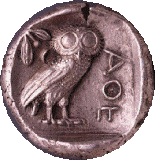
To the right you can see a 5th-century Greek coin showing the owl of Athena (whom the Romans called 'Minerva'). Athena, named after the city of Athens, was the goddess of wisdom, but also of arts and crafts and of war. According to ancient Greek mythology, Athena sprang fully grown from the head of her father, Zeus, the ruler of all other gods in the Olympus. The owl is her sacred bird because it is a symbol of wisdom.

History of Aesthetics Blog

Hello Good People,
Arthur has posted an invitation to discuss your summaries. Check it out by clicking on "comments" below or "History of Aesthetics Blog" above.

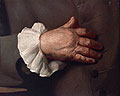
Here's a little art to get your brain juices flowing. I'm big fan of hands (perhaps Rodin & Camille Claudell are to blame). This one is by John Singleton Copley, an American painter (1738-1815). It is a detail from his Epes Sargent, ca. 1760 (National Gallery of Art, Washington, DC; image from www.artstor.org).